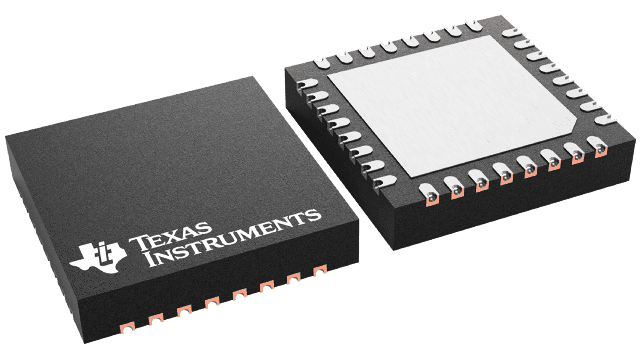
Packaging information
| Package | Pins VQFN (RHB) | 32 |
| Operating temperature range (°C) -40 to 125 |
| Package qty | Carrier 5,000 | LARGE T&R |
Features for the CC2340R5-Q1
Wireless microcontroller
- AEC-Q100 Grade 2 qualified for automotive applications
- Optimized 48MHz Arm Cortex-M0+ processor
- 512KB of in-system programmable flash
- 12KB of ROM for bootloader and drivers
-
2.4GHz RF transceiver compatible with Bluetooth 5.4 Low Energy
-
Up to 64KB of ultra-low leakage SRAM. Full RAM retention in standby mode
- Integrated balun
- Supports over-the-air upgrade (OTA)
- Serial wire debug (SWD)
Low power consumption
- MCU consumption:
- 2.6mA active mode, CoreMark
- 53µA/MHz running CoreMark
- < 710nA standby mode, RTC, 64KB RAM
- 165nA shutdown mode, wake-up on pin
- Radio consumption:
- 5.3mA RX
- 5.1mA TX at 0dBm
- < 11.0mA TX at +8dBm
Wireless protocol support
High-performance radio
- –102dBm for Bluetooth® Low Energy 125kbps
- –96.5dBm for Bluetooth® Low Energy 1Mbps
- Output power up to +8dBm with temperature compensation
Regulatory compliance
- Suitable for systems targeting compliance with these standards:
- EN 300 328 (Europe)
- FCC CFR47 Part 15
- ARIB STD-T66 (Japan)
MCU peripherals
- 19 I/O
Pads
- 2 IO pads SWD, muxed with GPIOs
- 2 IO pads LFXT, muxed with GPIOs
- 15 DIOs (analog or digital IOs)
- 3 × 16-bit and 1× 24-bit general-purpose timers, quadrature decode mode support
- 12-bit ADC, 1.2Msps with external reference, 267ksps with internal reference, eight external ADC inputs
- 1× low-power comparator
- 1× UART
- 1× SPI
- 1× I2C
- Real-time clock (RTC)
- Integrated temperature and battery monitor
- Watchdog timer
Security enablers
- AES 128-bit cryptographic accelerator
- Random number generator from on-chip analog noise
Product Cybersecurity Compliance
- ISO 21434 compliant (Cybersecurity Assurance Level 2)
- Developed for cybersecurity-relevant applications
- Documentation available to aid cybersecurity system design
Development tools and software
- LP-EM-CC2340R5 LaunchPad Development Kit
- SimpleLink™ CC23xx Software Development Kit (SDK)
- SmartRF™ Studio for simple radio configuration
- SysConfig system configuration tool
Operating range
- On-chip buck DC/DC converter
- 1.71V to 3.8V single supply voltage
- Tj: –40 to +125°C
- HBM ESD Classification Level 2 (ESD CDM level 1C on RF pin, per AEC-Q100 Rev. J)
- CDM ESD Classification Level 2A (ESD CDM level C1 on RF pin, per AEC-Q100 Rev. J)
RoHS-compliant package
- 5mm × 5mm RHB QFN32 with wettable flanks (19 GPIOs)
Description for the CC2340R5-Q1
The SimpleLink™CC2340R5-Q1 device is an AEC-Q100 compliant wireless microcontroller (MCU) targeting Bluetooth 5 Low Energy automotive applications. The device is optimized for low-power wireless communication in applications such as tire pressure monitoring systems (TPMS), car access, including key fobs used in passive entry passive start (PEPS) and remote keyless entry (RKE), cable replacement, and smartphone connectivity. The highlighted features of this device include:
- Support for Bluetooth 5 features: high-speed mode (2Mbps PHY), long-range (LE Coded 125kbps and 500kbps PHYs), privacy 1.2.1 and channel selection algorithm #2, as well as backward compatibility and support for key features from the Bluetooth 4.2 and earlier Low Energy specifications.
- Fully qualified Bluetooth 5.4 software protocol stack included with the SimpleLink™ CC23xx Software Development Kit (SDK)
- Ultra-low standby current less than 0.71µA with RTC operational and full RAM retention that enables significant battery life extension, especially for applications with longer sleep intervals.
- Integrated balun for reduced bill-of-material (BOM) board layout
- Excellent radio sensitivity and robustness (selectivity and blocking) performance for Bluetooth Low Energy (–102dBm for 125kbps LE Coded PHY, with integrated balun)
The CC2340R5-Q1 device is part of the SimpleLink™ MCU platform, which consists of Wi-Fi, Bluetooth Low Energy, Thread, Zigbee, Sub1GHz MCUs, and host MCUs that all share a common, easy-to-use development environment with a single core software development kit (SDK) and rich tool set. A one-time integration of the SimpleLink™ platform enables you to add any combination of the portfolio’s devices into your design, allowing 100 percent code reuse when your design requirements change. For more information, visit SimpleLink™ MCU platform.