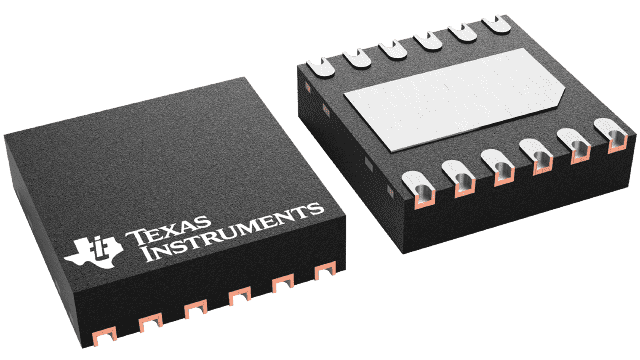
Packaging information
| Package | Pins WSON (DRR) | 12 |
| Operating temperature range (°C) -55 to 125 |
| Package qty | Carrier 3,000 | LARGE T&R |
Features for the LM7481
- Qualified for extended temperature applications
- Device temperature: –55°C to +125°C ambient operating temperature range
- 3-V to 65-V input range
- Reverse input protection down to –65 V
- Drives external back to back N-channel MOSFETs
- Ideal diode operation with 9.1-mV A to C forward voltage drop regulation
- Low reverse detection threshold (–4 mV) with fast response (0.5 µs)
- Active rectification up to 200-KHz
- 60-mA peak gate (DGATE) turn-on current
- 2.6-A peak DGATE turnoff current
- Integrated 3.8-mA charge pump
- Adjustable overvoltage protection
- Low 2.87-µA shutdown current (EN/UVLO=Low)
- 2.6-A peak DGATE turn-off current
- Meets automotive ISO7637 transient requirements with a suitable TVS diode
- Available in space saving 12-pin WSON package
Description for the LM7481
The LM74810 ideal diode controller drives and controls external back to back N-channel MOSFETs to emulate an ideal diode rectifier with power path ON/OFF control and overvoltage protection. The wide input supply of 3V to 65V allows protection and control of 12-V and 24-V input powered systems. The device can withstand and protect the loads from negative supply voltages down to –65-V. An integrated ideal diode controller (DGATE) drives the first MOSFET to replace a Schottky diode for reverse input protection and output voltage holdup. With a second MOSFET in the power path the device allows load disconnect (ON/OFF control) and overvoltage protection using HGATE control. The device features an adjustable overvoltage cut-off protection feature. LM74810 employs reverse current blocking using linear regulation and comparator scheme. With common drain configuration of the power MOSFETs, the mid-point can be utilized for OR-ing designs using another ideal diode. The LM74810 has a maximum voltage rating of 65V. The loads can be protected from extended overvoltage transients like 200-V unsuppressed load dumps in 24-V battery systems by configuring the device with external MOSFETs in common source topology.