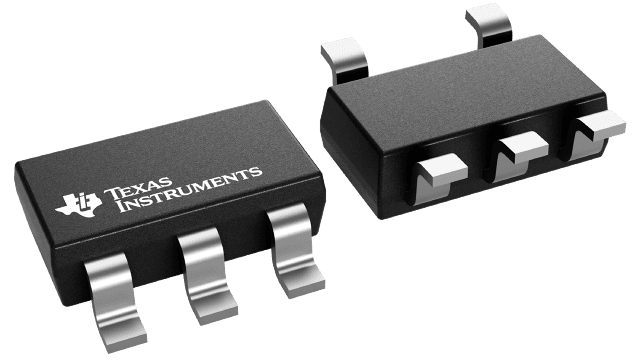
Packaging information
| Package | Pins SOT-23-THN (DDC) | 5 |
| Operating temperature range (°C) -40 to 125 |
| Package qty | Carrier 3,000 | LARGE T&R |
Features for the REF20-Q1
- AEC-Q100 qualified with the following results:
- Device temperature grade 1: –40°C to +125°C ambient operating temperature
- Device HBM ESD classification level 2
- Device CDM ESD classification level C7B
- Functional Safety-Capable
- Two Outputs, VREF and VREF / 2, for convenient use in single-supply systems
- Excellent temperature drift performance:
- 8 ppm/°C (maximum) from –40°C to 125°C
- High initial accuracy: ±0.05% (maximum)
- VREF and VBIAS tracking
overtemperature:
- 7 ppm/°C (maximum) from –40°C to 125°C
- Microsize package: SOT23-5
- Low dropout voltage: 10 mV
- High output current: ±20 mA
- Low quiescent current: 360 µA
- Line regulation: 3 ppm/V
- Load regulation: 8 ppm/mA
Description for the REF20-Q1
Applications with only a positive supply voltage often require additional stable voltage in the middle of the analog-to-digital converter (ADC) input range to bias input bipolar signals. The REF20xx-Q1 provides a reference voltage (VREF) for the ADC and a second highly-accurate voltage (VBIAS) that can be used to bias the input bipolar signals.
The REF20xx-Q1 offers excellent temperature drift (8 ppm/°C, maximum) and initial accuracy (0.05%) on both the VREF and VBIAS outputs while operating at a quiescent current less than 430 µA. In addition, the VREF and VBIAS outputs track each other with a precision of 7 ppm/°C (maximum) across the temperature range of –40°C to 125°C. All these features increase the precision of the signal chain and decrease board space, while reducing the cost of the system as compared to a discrete solution. Extremely low dropout voltage of only 10 mV allows operation from very low input voltages, which can be very useful in battery-operated systems.
Both the VREF and VBIAS voltages have the same excellent specifications and can sink and source current equally well. Very good long-term stability and low noise levels make these devices ideally-suited for high-precision applications.