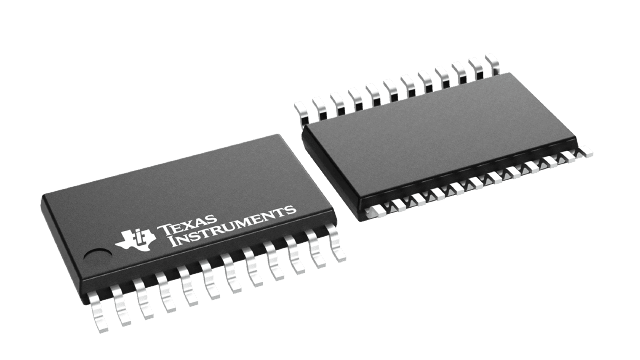
Packaging information
| Package | Pins TSSOP (PW) | 24 |
| Operating temperature range (°C) -40 to 85 |
| Package qty | Carrier 60 | TUBE |
Features for the SN74GTLP817
- OEC™ Circuitry Improves Signal Integrity and Reduces Electromagnetic Interference
- Bidirectional Interface Between GTLP Signal Levels and LVTTL Logic Levels
- GTLP-to-LVTTL 1-to-6 Fanout Driver
- LVTTL-to-GTLP 1-to-2 Fanout Driver
- LVTTL Interfaces Are 5-V Tolerant
- Medium-Drive GTLP Outputs (50 mA)
- Reduced-Drive LVTTL Outputs (\x9612 mA/12 mA)
- Variable Edge-Rate Control (ERC) Input Selects GTLP Rise and Fall Times for Optimal Data-Transfer Rate and Signal Integrity in Distributed Loads
- Ioff and Power-Up 3-State Support Hot Insertion
- Distributed VCC and GND Pins Minimize High-Speed Switching Noise
- Latch-Up Performance Exceeds 100 mA Per JESD 78, Class II
- ESD Protection Exceeds JESD 22
- 2000-V Human-Body Model (A114-A)
- 200-V Machine Model (A115-A)
- 1000-V Charged-Device Model (C101)
OEC and TI are trademarks of Texas Instruments.
Description for the SN74GTLP817
The SN74GTLP817 is a medium-drive fanout driver that provides LVTTL-to-GTLP and GTLP-to-LVTTL
signal-level translation. The device provides a high-speed interface between cards operating at LVTTL logic
levels and a backplane operating at GTLP signal levels. High-speed (about three times faster than standard
TTL or LVTTL) backplane operation is a direct result of GTLP reduced output swing (<1 V), reduced input
threshold levels, improved differential input, and OEC™ circuitry. The improved GTLP OEC circuitry minimizes
bus settling time and has been designed and tested using several backplane models. The medium drive allows
incident-wave switching in heavily loaded backplanes with equivalent load impedance down to 19  . BO1 and
BO2 can be tied together to drive an equivalent load impedance down to 11 .
. BO1 and
BO2 can be tied together to drive an equivalent load impedance down to 11 .
GTLP is the Texas Instruments (TI™) derivative of the Gunning Transceiver Logic (GTL) JEDEC standard JESD 8-3. The ac specification of the SN74GTLP817 is given only at the preferred higher noise-margin GTLP, but the user has the flexibility of using this device at either GTL (VTT = 1.2 V and V REF = 0.8 V) or GTLP (VTT = 1.5 V and VREF = 1 V) signal levels.
Normally, the B port operates at GTLP signal levels. The A-port and control inputs operate at LVTTL logic levels but are 5-V tolerant and are compatible with TTL and 5-V CMOS inputs. VREF is the B-port differential input reference voltage.
GNDT is the TTL output ground, while GNDG is the GTLP output ground, and both may be separated from each other for a quieter device.
This device is fully specified for hot-insertion applications using Ioff and power-up 3-state. The Ioff circuitry disables the outputs, preventing damaging current backflow through the device when it is powered down. The power-up 3-state circuitry places the outputs in the high-impedance state during power up and power down, which prevents driver conflict.
This device features adjustable edge-rate control (ERC). Changing the ERC input voltage between GND and VCC adjusts the B-port output rise and fall times. This allows the designer to optimize system data-transfer rate and signal integrity to the backplane load. ERC automatically is selected to the same speed as alternate source 1-to-6 fanout drivers that use pin 18 for 3.3-V or 5-V VCC .
When VCC is between 0 and 1.5 V, the device is in the high-impedance state during power up or power down. However, to ensure the high-impedance state above 1.5 V, the output-enable (OE\) input should be tied to VCC through a pullup resistor; the minimum value of the resistor is determined by the current-sinking capability of the driver.