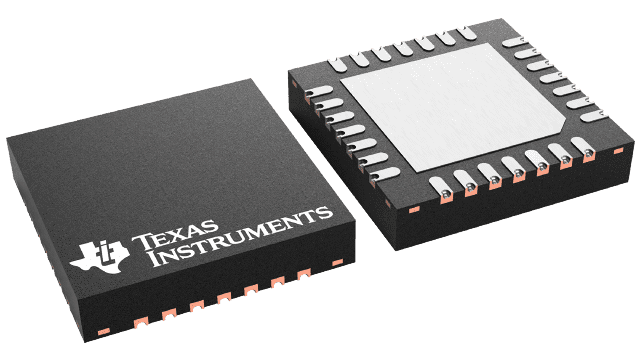
Packaging information
| Package | Pins VQFN (RHD) | 28 |
| Operating temperature range (°C) -40 to 125 |
| Package qty | Carrier 250 | SMALL T&R |
Features for the TPS65653-Q1
- AEC-Q100
qualified with the following results:
- Device temperature grade 1: –40°C to +125°C ambient operating temperature
- Input voltage: 2.8 V to 5.5 V
- Two high-efficiency step-down DC/DC converters:
- Output voltage: 1 V to 3.36 V
- Maximum output current 3 A
- Programmable output-voltage slew rate from 0.5 mV/µs to 10 mV/µs
- 4-MHz Switching frequency
- Spread-spectrum mode and phase interleaving for EMI reduction
- Configurable general-purpose output signals (GPO, GPO2)
- I2C-compatible interface supporting standard (100 kHz), fast (400 kHz), fast+ (1 MHz), and high-speed (3.4 MHz) modes
- Interrupt function with programmable masking
- Programmable power-good signal (PGOOD)
- External clock input to synchronize switching
- Output short-circuit and overload protection
- Overtemperature warning and protection
- Overvoltage protection (OVP) and undervoltage lockout (UVLO)
- 28-pin, 5-mm × 5-mm VQFN package with wettable flanks
Description for the TPS65653-Q1
The TPS65653-Q1 is designed to provide a tight power specification for noise sensitive applications, such as radar. The device contains two step-down DC/DC converters and general-purpose digital-output signals. The device is controlled by an I2C-compatible serial interface and by an enable signal.
The automatic PWM/PFM (AUTO mode) operation gives high efficiency over a wide output-current range. The TPS65653-Q1 supports remote voltage sensing to compensate IR drop between the regulator output and the point-of-load (POL) thus improving the accuracy of the output voltage. In addition the switching clock can be forced to PWM mode and also synchronized to an external clock to minimize the disturbances.
The TPS65653-Q1 device supports programmable start-up and shutdown delays and sequences including GPO signals synchronized to the enable signal. During start-up and voltage change, the device controls the output slew rate to minimize output voltage overshoot and the in-rush current.