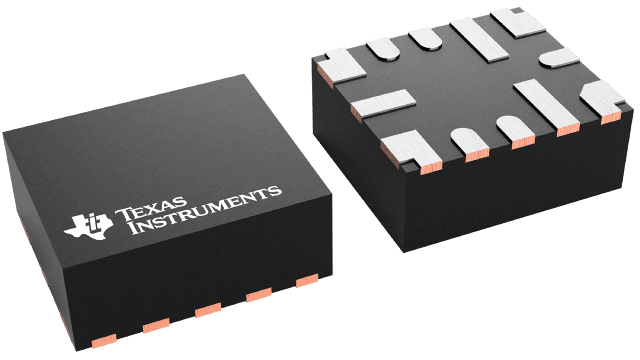
Packaging information
| Package | Pins VQFN-HR (RPS) | 12 |
| Operating temperature range (°C) -40 to 125 |
| Package qty | Carrier 3,000 | LARGE T&R |
Features for the TPS7A52
- 0.5% (max) accuracy over line, load, and temperature with BIAS
- Output voltage noise: 4.4 µVRMS
- Low dropout: 65 mV (max) at 2 A with BIAS
- Output voltage noise: 4.4 µVRMS
- Power-supply ripple rejection:
- 40 dB at 500 kHz
- Input voltage range:
- Without BIAS: 1.4 V to 6.5 V
- With BIAS: 1.1 V to 6.5 V
- Adjustable output voltage range: 0.8 V to 5.2 V
- Adjustable soft-start inrush control
- Open-drain, power-good (PG) output
- 2.2-mm × 2.5-mm, 12-pin VQFN package
Description for the TPS7A52
The TPS7A52 is a low-noise (4.4 µVRMS), ultra-low dropout linear regulator (LDO) capable of sourcing 2 A with only 65 mV of maximum dropout. The device output voltage is adjustable from 0.8 V to 5.2 V using an external resistor divider.
The combination of low noise (4.4 µVRMS), high PSRR, and high output current capability makes the TPS7A52 an excellent choice to power noise-sensitive components such as those found in high-speed communications, video, medical, or test-and-measurement applications. The high performance of this device limits power-supply-generated phase noise and clock jitter, making this device ideal for powering high-performance serializer and deserializer (SerDes), analog-to-digital converters (ADCs), and digital-to-analog converters (DACs). Specifically, RF amplifiers benefit from the high performance and 5.2-V output capability of the device.
For digital loads [such as application-specific integrated circuits (ASICs), field-programmable gate arrays (FPGAs), and digital signal processors (DSPs)] requiring low-input voltage, low-output (LILO) voltage operation, the exceptional accuracy (0.5% over load and temperature), remote sensing, excellent transient performance, and soft-start capabilities of the TPS7A52 provides optimal system performance.
As an adjustable voltage regulator, there is versatility in the design of the TPS7A52 that makes the device a component of choice for analog loads such as voltage-controlled oscillator (VCO), ADC, DAC, and imaging sensors and for digital loads such as SerDes, FPGAs, and DSPs.