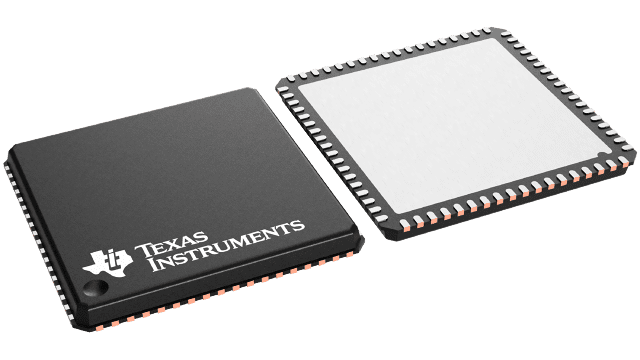
Packaging information
| Package | Pins VQFNP (RMP) | 72 |
| Operating temperature range (°C) -40 to 85 |
| Package qty | Carrier 168 | JEDEC TRAY (5+1) |
Features for the ADS54J64
- Quad Channel, 14-Bit Resolution
- Maximum Sampling Rate: 1 GSPS
- Maximum Output Sample Rate: 500 MSPS
- High-Impedance Analog Input Buffer
- Analog Input Bandwidth (–3 dB): 1 GHz
- Output Options:
- Digital Down Conversion (DDC) Using 16-Bit NCO
- DDC Bypass With Full Rate Output Up to 500 MSPS
- Differential Full-Scale Input: 1.1 VPP
- JESD204B Interface:
- Subclass 1 Support
- 1 Lane per ADC Up to 10 Gbps
- Dedicated SYNC Pin for Pair of Channels
- Support for Multi-Chip Synchronization
- Spectral Performance:
- fIN = 190-MHz IF at –1
dBFS:
- SNR: 69 dBFS
- NSD: –153 dBFS/Hz
- SFDR: 86 dBc (HD2,
HD3),
95 dBFS (Non HD2, HD3)
- fIN =
370-MHz IF at –3 dBFS:
- SNR: 68.5 dBFS
- NSD: –152.5 dBFS/Hz
- SFDR: 80 dBc
(HD2, HD3),
86 dBFS (Non HD2, HD3)
- fIN = 190-MHz IF at –1
dBFS:
- 72-Pin VQFN Package (10 mm × 10 mm)
- Power Consumption: 625 mW/Ch, 2.5 W Total
- Power Supplies: 1.15 V, 1.15 V, 1.9 V
Description for the ADS54J64
The ADS54J64 device is a quad-channel, 14-bit,
1-GSPS, analog-to-digital converter (ADC) offering wide-bandwidth, 2x oversampling and high
SNR. The ADS54J64 supports a JESD204B serial interface with data rates up to 10 Gbps with one lane
per channel. The buffered analog input provides uniform impedance across a wide frequency range and
minimizes sample-and-hold glitch energy. The ADS54J64 provides excellent spurious-free dynamic
range (SFDR) over a large input frequency range with very low power consumption. The digital signal
processing block includes complex mixers followed by low-pass filters with decimate-by-2 and -4
options supporting up to a 200-MHz receive bandwidth. The ADS54J64 also supports a 14-bit, 500-MSPS
output in DDC bypass mode.
A four-lane JESD204B interface simplifies connectivity, allowing high system integration density. An internal phase-locked loop (PLL) multiplies the incoming ADC sampling clock to derive the bit clock that is used to serialize the 14-bit data from each channel.