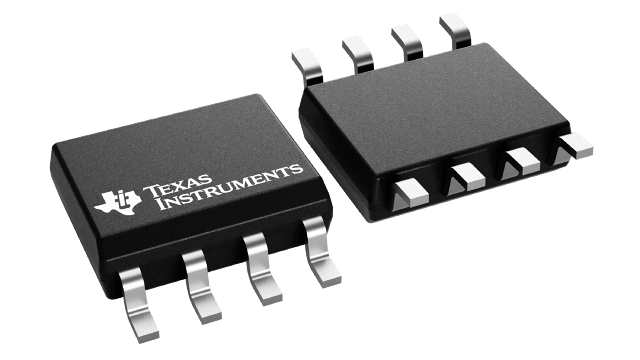
Packaging information
| Package | Pins SOIC (D) | 8 |
| Operating temperature range (°C) -40 to 85 |
| Package qty | Carrier 2,500 | LARGE T&R |
Features for the SN65LBC176A
- Designed for signaling rates(1) up to 30 Mbps
- Bus-Pin ESD protection exceeds 12 kV HBM
- Compatible with ANSI standard TIA/EIA-485-A and ISO 8482:1987(E)
- Low Skew
- Designed for multipoint transmission on long bus lines in noisy environments
- Very low disabled supply-current requirements: 700 mA maximum
- Common mode voltage range of –7 V to 12 V
- Thermal-shutdown protection
- Driver positive and negative current limiting
- Open-circuit failsafe receiver design
- Receiver input sensitivity: ±200 mV Maximum
- Receiver input hysteresis: 50 mV typical
- Glitch-free power-up and power-down protection
- Available in Q-temp automotive
- High reliability automotive applications
- Configuration control / print support
- Qualification to automotive standards
(1)Signaling rate by TIA/EIA-485-A definition restrict transition times to 30% of the bit duration, and much higher signaling rates may be achieved using a different criteria (see the Typical Characteristics section).
Description for the SN65LBC176A
The SN65LBC176A, SN65LBC176AQ, and SN75LBC176A differential bus transceivers are monolithic, integrated circuits designed for bidirectional data communication on multipoint bus-transmission lines. They are designed for balanced transmission lines and are compatible with ANSI standard TIA/EIA-485-A and ISO 8482. The A version offers improved switching performance over its predecessors without sacrificing significantly more power.
The SN65LBC176A, SN65LBC176AQ, and SN75LBC176A combine a 3-state, differential line driver and a differential input line receiver, both of which operate from a single 5-V power supply. The driver and receiver have active-high and active-low enables, respectively, which can externally connect together to function as a direction control. The driver differential outputs and the receiver differential inputs connect internally to form a differential input /output (I/O) bus port that is designed to offer minimum loading to the bus whenever the driver is disabled or VCC = 0. This port features wide positive and negative common-mode voltage ranges, making the device suitable for party-line applications. Very low device supply current can be achieved by disabling the driver and the receiver.