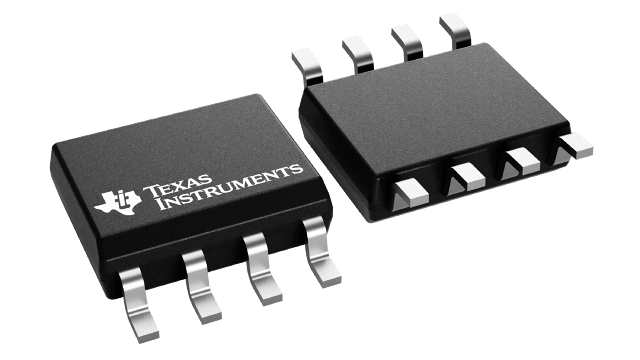
Packaging information
| Package | Pins SOIC (D) | 8 |
| Operating temperature range (°C) -40 to 85 |
| Package qty | Carrier 75 | TUBE |
Features for the SN65MLVD200
- Low-Voltage Differential 30-
 up to 100 Mbps
 - Power Dissipation at 100 Mbps
- Driver: 50 mW Typical
- Receiver: 30 mW Typical
- Meets or Exceeds Current Revision of M-LVDS Standard TIA/EIA–899 for Multipoint Data Interchange
- Controlled Driver Output Voltage Transition Times for Improved Signal Quality
- –1-V to 3.4-V Common-Mode Voltage Range Allows Data Transfer With up to 2 V of Ground Noise
- Type-1 Receivers Incorporate 25 mV of Hysteresis
- Type-2 Receivers Provide an Offset (100 mV) Threshold to Detect Open-Circuit and Idle-Bus Conditions
- Operates From a Single 3.3-V Supply
- Propagation Delay Times Typically 2.3 ns for Drivers and 5 ns for Receivers
- Power-Up/Down Glitch-Free Driver
- Driver Handles Operation Into a Continuous Short Circuit Without Damage
- Bus Pins High Impedance When Disabled or VCC ≤ 1.5V
- 200-Mbps Devices Available (SN65MLVD201, 203, 206, and 207)
The signaling rate of a line is the number of voltage transitions that are made per second expressed in bps (bits per second) units.
Description for the SN65MLVD200
This series of SN65MLVD20x devices are low-voltage differential line drivers and receivers complying with the proposed multipoint low-voltage differential signaling (M-LVDS) standard (TIA/EIA–899). These circuits are similar to their TIA/EIA-644 standard compliant LVDS counterparts, with added features to address multipoint applications. Driver output current has been increased to support doubly-terminated, 50- load multipoint applications. Driver output slew rates are optimized for signaling rates up to 100 Mbps.
Types 1 and 2 receivers are available. Both types of receivers operate over a common-mode voltage range of –1 V to 3.4 V to provide increased noise immunity in harsh electrical environments. Type-1 receivers have their differential input voltage thresholds near zero volts (±50 mV), and include 25 mV of hysteresis to prevent output oscillations in the presence of noise. Type-2 receivers include an offset threshold to detect open-circuit, idle-bus, and other fault conditions, and provide a known output state under these conditions.
The intended application of these devices is in half-duplex or multipoint baseband data transmission over controlled impedance media of approximately 100- characteristic impedance. The transmission media may be printed circuit board traces, backplanes, or cables. (Note: The ultimate rate and distance of data transfer is dependent upon the attenuation characteristics of the media, the noise coupling to the environment, and other application-specific characteristics).
These devices are characterized for operation from –40°C to 85°C.