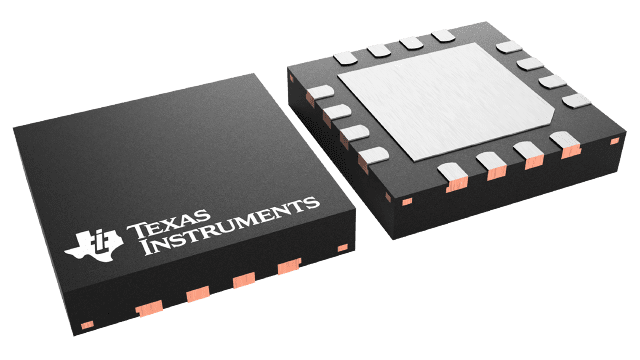
Packaging information
| Package | Pins WQFN (RUM) | 16 |
| Operating temperature range (°C) -40 to 125 |
| Package qty | Carrier 3,000 | LARGE T&R |
Features for the SN65MLVD204B
- Compatible with the M-LVDS Standard TIA/EIA-899 for Multipoint Data Interchange
- Low-Voltage Differential 30-Ω to 55-Ω Line Drivers and Receivers for Signaling Rates(1) Up to 100 Mbps, Clock Frequencies up to 50 MHz
- Type-2 Receiver Provides an Offset Threshold to Detect Open-Circuit and Idle-Bus Conditions
- Bus I/O Protection
- >±8-kV HBM
- >±8-kV IEC 61000-4-2 Contact Discharge
- Controlled Driver Output Voltage Transition Times for Improved Signal Quality
- -1-V to 3.4-V Common-Mode Voltage Range Allows Data Transfer With 2 V of Ground Noise
- Bus Pins High Impedance When Disabled or VCC ≤ 1.5 V
- 200-Mbps Device Available (SN65MLVD206B)
- Improved Alternatives to SN65MLVD204A
Description for the SN65MLVD204B
The SN65MLVD204B device is a multipoint-low-voltage differential (M-LVDS) line drivers and receivers which are optimized to operate at signaling rates up to 100 Mbps. This device family has robust 3.3-V drivers and receivers in the standard SOIC and QFN footprint for demanding industrial applications. The bus pins are robust to ESD events, with high levels of protection to human-body model and IEC contact discharge specifications.
The SN65MLVD204B combine a differential driver and a differential receiver (transceiver), which operate from a single 3.3-V supply. The transceivers are optimized to operate at signaling rates up to 100 Mbps.
The SN65MLVD204B has enhancements over similar devices. Improved features include a controlled slew rate on the driver output to help minimize reflections from unterminated stubs, resulting in better signal integrity. The same footprint definition was maintained, allowing for an easy drop-in replacement for a system performance upgrade. The devices are characterized for operation from –40°C to 85°C.
The SN65MLVD204B M-LVDS transceivers are part of TI’s extensive M-LVDS portfolio.
(1)The signaling rate of a line is the number of voltage transitions that are made per second expressed in the bps of the unit (bits per second).