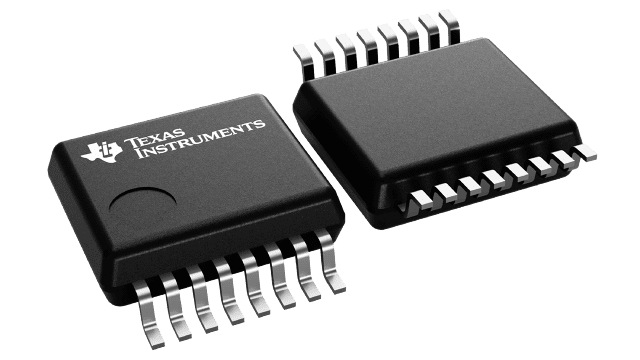
Packaging information
| Package | Pins SSOP (DB) | 16 |
| Operating temperature range (°C) 0 to 70 |
| Package qty | Carrier 2,000 | LARGE T&R |
Features for the TRSF3221E
- ESD protection for RS-232 pins
- ±15kV Human-body model (HBM)
- ±8kV IEC 61000-4-2 Contact discharge
- ±15kV IEC 61000-4-2 Air-gap discharge
- Operates with 3V to 5.5V VCC supply
- Operates up to 1Mbit/s
- Low-speed pin-compatible device (250kbit/s) – TRS3221E
- Available in near chip-scale package, 16-pin VQFN (RGT, 82% smaller than TSSOP package)
- Low standby current: 1µA typical
- External capacitors : 4 × 0.1µF
- Accepts 5V logic input with 3.3V supply
- Auto-powerdown feature automatically disables drivers for power savings
Description for the TRSF3221E
The TRSF3221E consists of one line driver, one line receiver, and a dual charge-pump circuit with ±15kV IEC ESD protection pin to pin (serial-port connection pins, including GND). The TRSF3221E provides the electrical interface between an asynchronous communication controller and the serial-port connector. The charge pump and four small external capacitors allow operation from a single 3V to 5.5V supply. The TRSF3221E operates at data signaling rates up to 1Mbit/s and a driver output slew rate of 24V/µs to 150V/µs.
Flexible control options for power management are available when the serial port is inactive. The auto-powerdown feature functions when FORCEON is low and FORCEOFF is high. During this mode of operation, if the TRSF3221E does not sense a valid RS-232 signal on the receiver input, the driver output is disabled. If FORCEOFF is set low and the enable (EN) input is high, both the driver and receiver are shut off, and the supply current is reduced to 1µA. Disconnecting the serial port or turning off the peripheral drivers causes the auto-powerdown condition to occur. Auto-powerdown can be disabled when FORCEON and FORCEOFF are high. With auto-powerdown enabled, the device is activated automatically when a valid signal is applied to the receiver input. The INVALID output notifies the user if an RS-232 signal is present at the receiver input. INVALID is high (valid data) if the receiver input voltage is greater than 2.7V or less than –2.7V, or has been between –0.3V and 0.3V for less than 30µs. INVALID is low (invalid data) if the receiver input voltage is between –0.3V and 0.3V for more than 30µs. See Figure 6-5 for receiver input levels.