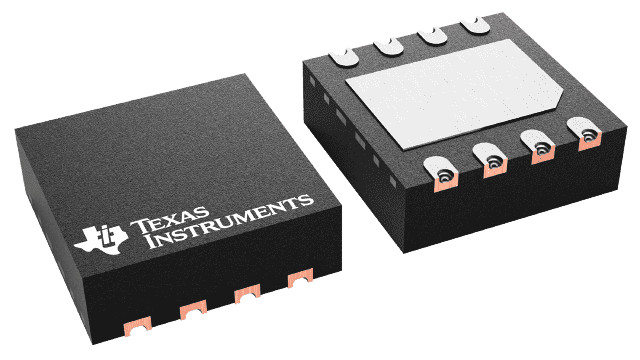
패키징 정보
| 패키지 | 핀 VSON (DRB) | 8 |
| 작동 온도 범위(°C) -40 to 125 |
| 패키지 수량 | 캐리어 3,000 | LARGE T&R |
TPS7B84-Q1의 주요 특징
- AEC-Q100 qualified for automotive
applications:
- Temperature grade 1: –40°C to +125°C, TA
- Junction temperature: –40°C to +150°C, TJ
- Input voltage range: 3V to 40V (42V max)
- Output voltage range:
- Adjustable output: 1.2V to 18V
- Fixed output: 3.3V and 5V
- Output current: up to 150mA
- Output voltage accuracy: ±0.75% (max)
- Low dropout voltage:
- 225mV (max) at 150mA (VOUT ≥ 3.3V)
- Low quiescent current:
- 18µA (typ)
- 4µA (max) when disabled
- Excellent line transient response:
- ±2% VOUT deviation during cold-crank
- ±2% VOUT deviation (1V/µs VIN slew rate)
- Stable with a 2.2µF or larger capacitor
- Functional Safety-Capable
- Package options:
- DRB (8-pin VSON), RθJA: 50.8°C/W
- DCY (4-pin SOT-223), RθJA: 85.5°C/W
TPS7B84-Q1에 대한 설명
The TPS7B84-Q1 is a low-dropout linear regulator designed to connect to the battery in automotive applications. The device has an input voltage range extending to 40V, which allows the device to withstand transients (such as load dump) that are anticipated in automotive systems. With only an 18µA quiescent current, the device is an optimal solution for powering always-on components such as microcontrollers (MCUs) and controller area network (CAN) transceivers in standby systems.
The TPS7B84-Q1 has both fixed and adjustable output types. The wide output voltage range allows the device to generate the bias voltage for silicon carbide (SiC) gate drivers and microphones as well as power MCUs and processors.
The device has state-of-the-art transient response that allows the output to quickly react to changes in load or line (for example, during cold-crank conditions). Additionally, the device has a novel architecture that minimizes output overshoot when recovering from dropout. During normal operation, the device has a tight DC accuracy of ±0.75% over line, load, and temperature.
The device is available in both a SOT223 package and a small VSON package with wettable flanks that facilitates a compact printed circuit board (PCB) design. The low thermal resistance enables sustained operation despite significant dissipation across the device.